
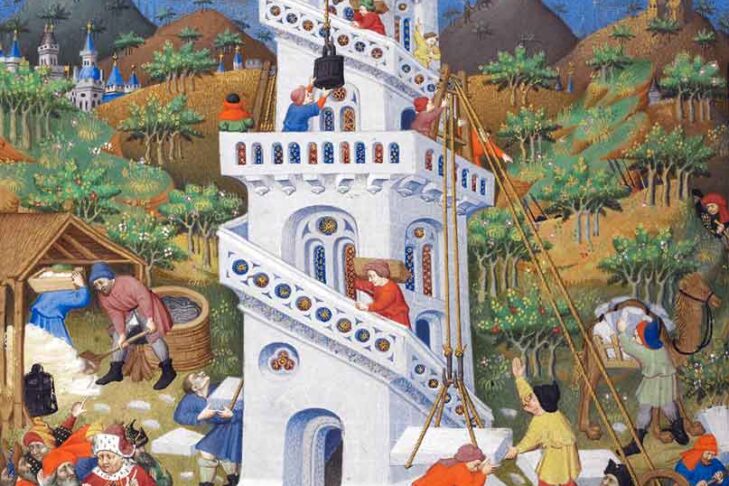
There doesn’t seem to be anything particularly wicked about the Tower of Babel.
No murder is mentioned. No theft. No war. Instead, the Torah describes people doing things we normally admire: working together, developing new technology, building a city, and pursuing an ambitious goal.
“The entire earth was of one language and uniform words” (Genesis 11:1).
Then G-d breaks them apart.
Why?
Living in a region without abundant stone, the people discovered how to manufacture their own: “Come, let us make bricks and fire them thoroughly.” The Torah adds, “the bricks were to them for stones” (Genesis 11:3).
It was an impressive technological advance. Suddenly they could manufacture the materials they needed and construct something unprecedented: “a city and a tower with its top in the heavens.”
Yet the Torah does not condemn their ingenuity. The clue appears in what they intended to accomplish:
“Let us make ourselves a name, lest we be scattered upon the face of the entire earth” (Genesis 11:4).
They had unity, technology and ambition. But what would all that power serve?
G-d Himself acknowledges the extraordinary force of their cooperation: “Behold, they are one people, and they all have one language… and now nothing will be withheld from them that they propose to do” (Genesis 11:6).
Their unity had given them enormous power. But the Torah immediately forces us to ask a more important question: What happens when everyone is united behind a project that has forgotten the value of the individual?
An ancient Midrash reveals what had happened at Babel. As the tower rose higher, transporting bricks upward became increasingly difficult. If a worker fell to his death, construction continued. But if a brick fell and shattered, the builders mourned the loss.
They knew the price of a brick and forgot the value of a person.
The project had become more important than the people building it.
There is something revealing about the brick itself. Unlike stones found in nature, bricks are manufactured to be uniform. If one breaks, another can take its place.
That is useful when constructing a building.
It is terrifying when constructing a society.
Just two chapters earlier, after the Flood, G-d had given Noah the foundation for human dignity: “For in the image of G-d He made man” (Genesis 9:6).
The contrast could hardly be sharper.
G-d says: a person is an image.
Babel says: a person is a brick.
One bears something of the Divine that no other human being can replace. The other is valuable primarily for the function it performs.
That temptation did not disappear when the tower fell.
Human beings accomplish extraordinary things by working together. But every organization, community and institution faces the same danger: achieving the goal can eventually become more important than the people it was supposed to serve.
We begin measuring success by how high the tower rises rather than by what happens to the people carrying the bricks.
The Torah’s answer is not to reject ambition, technology or unity. It is to insist that they serve something higher. The real measure of our accomplishments is what happens to the human beings along the way.
The builders of Babel learned how to manufacture something remarkable: a stone made by human hands.
Their tragedy began when they forgot the difference between what they had made and the people G-d had made.
Bricks can be replaced.
People cannot.
I wish you a good week and Shabbat Shalom,
Rabbi Yonatan Hambourger
This post has been contributed by a third party. The opinions, facts and any media content are presented solely by the author, and Atlanta Jewish Connector assumes no responsibility for them. Want to add your voice to the conversation? Publish your own post here.