
We spend much of our lives trying to make tomorrow less uncertain.
We build sturdy homes, save money, buy insurance, schedule checkups, and make plans for things that haven’t happened yet. Much of this is wise and responsible. But beneath it lies a very human hope: if we prepare carefully enough, perhaps we can make ourselves secure.
Then comes Sukkot, and the Torah tells us to do something peculiar:
“You shall dwell in booths for seven days” (Leviticus 23:42).
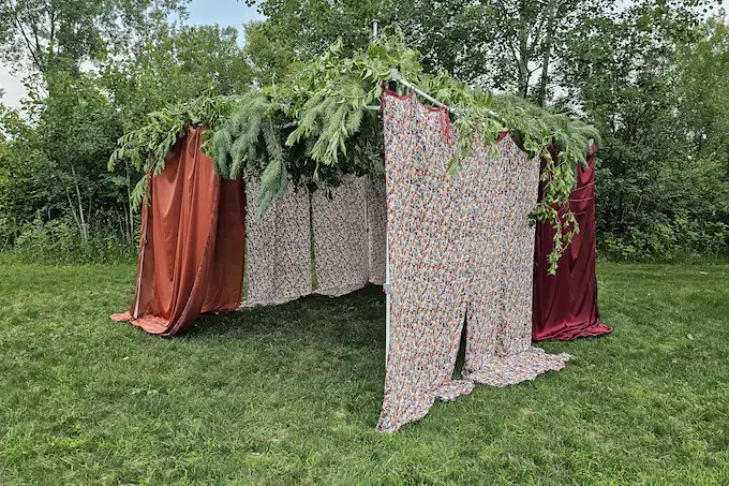
For one week, Jews leave their homes and eat—and traditionally even sleep—in a temporary hut called a sukkah. Its roof is made from branches or other natural material. It provides shade but little protection from a serious rainstorm.
Stranger still, Sukkot is the holiday the Torah repeatedly associates with joy: “You shall rejoice in your festival” (Deuteronomy 16:14).
Why would G-d teach us about joy by asking us to leave the place where we feel most secure?
The answer begins thousands of years ago in the wilderness.
After leaving Egypt, the Israelites spent forty years traveling through a barren desert. They had no permanent homes, farms, or fortified cities. Yet Jewish tradition describes those years as a time of extraordinary Divine protection, when G-d surrounded them with miraculous clouds that sheltered and guided them. Each year, Sukkot asks us to recreate something of that experience.
But the sukkah does not teach that houses are unimportant. Judaism does not glorify recklessness. When the holiday ends, we go home. We repair the roof when it leaks and lock the doors at night.
The lesson is subtler: Do not confuse the things through which G-d protects us with the One who protects us.
We naturally place our confidence in what we can see and measure: the house, the bank account, the job, the doctor’s report, the carefully constructed plan. All of these matter, and we are responsible for using them wisely. But none can guarantee tomorrow—and for seven days, the sukkah makes that truth impossible to ignore.
Chassidic teaching describes the sukkah as G-d’s embrace, an image the Lubavitcher Rebbe often developed. Unlike many commandments performed with one particular part of the body, we enter the sukkah completely. Our head is inside. Our heart is inside. Even our shoes are inside. The entire person is surrounded.
And there is the paradox at the heart of Sukkot: we sit beneath a roof that cannot guarantee our security and discover that we are still surrounded.
That helps explain the holiday’s extraordinary joy. Its joy does not come from pretending life is predictable. It comes from discovering that our peace never depended entirely upon predictability in the first place.
Sukkot does not ask us to stop preparing for tomorrow. Build the house. Save for the future. Visit the doctor. Make the plan.
But don’t mistake any of them for a guarantee.
For one week each year, Jews leave the strongest roof they own and sit beneath branches through which they can sometimes see the sky.
And there, beneath the least dependable roof imaginable, the Torah tells us to rejoice.
Because sometimes we have to step outside the house to remember what has been holding us all along.
I wish you a good week and Shabbat Shalom,
Rabbi Yonatan Hambourger
This post has been contributed by a third party. The opinions, facts and any media content are presented solely by the author, and Atlanta Jewish Connector assumes no responsibility for them. Want to add your voice to the conversation? Publish your own post here.