Have you ever had someone see something in you that you couldn’t see in yourself?
A teacher recognizes a gift you never suspected. An employer entrusts you with a responsibility you feel unprepared to carry.
Sometimes the most unsettling thing another person can tell us is not that we’ve failed, but that we haven’t yet become who we could be.
Jacob’s famous dream of a ladder offers a surprising answer.
Fleeing his brother Esau, Jacob leaves his parents’ home and journeys toward Haran. Night falls, and he lies down to sleep beneath the open sky.
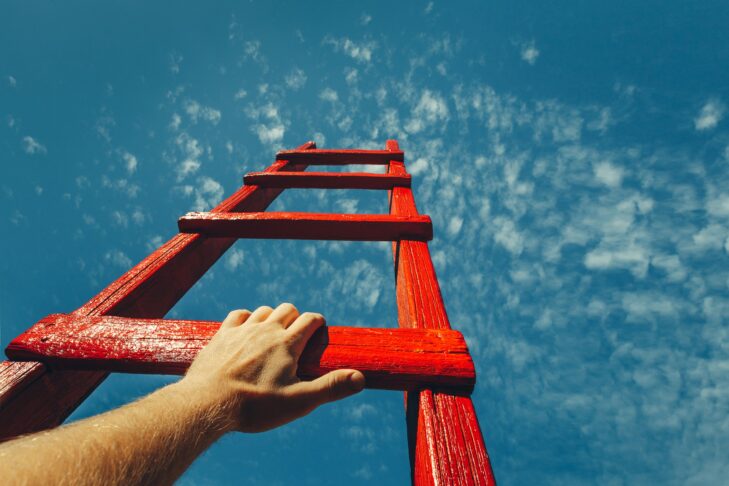
He dreams of a ladder standing on the earth, its top reaching heaven, with angels ascending and descending upon it (Genesis 28:12).
Most readers picture angels traveling between heaven and earth. But an ancient Midrash, a rabbinic interpretation, offers a startling possibility.
The angels ascend to heaven and behold Jacob’s image engraved near the Divine Throne. Then they descend and discover Jacob himself, sleeping on the ground.
They can scarcely believe what they see.
Here is the man whose image occupies such an exalted place in heaven—and down on earth, he’s asleep!
The Midrash is not criticizing Jacob for needing rest. It points toward the distance between who Jacob presently is and who he is capable of becoming.
Rabbi Adin Even-Israel Steinsaltz develops this teaching into a profound lesson about human responsibility.
Jacob has spent his life surrounded by spiritual greatness. His father Isaac is a towering figure of faith. His home offers the security of familiar beliefs and values.
Within that protected world, Jacob can be righteous without discovering the full measure of his own strength.
But now he must leave.
In Haran, his dishonest uncle Laban will test him repeatedly. Jacob will work for years, marry, raise children, and struggle to provide for his family.
The world outside his parents’ home will demand qualities he has never needed to exercise.
The heavenly image does not represent a different Jacob. It represents possibilities already present within him, waiting to be realized.
Consider a young person raised in a loving home, surrounded by guidance and protection. Eventually, that person must make decisions without someone nearby to explain what is right.
Values learned at home must become convictions strong enough to withstand pressure. Honesty must survive situations where dishonesty would be easier. Kindness must become the courage to act when helping someone is inconvenient.
Only then do those values truly become one’s own.
Jacob’s journey is the beginning of that transformation.
And the ladder offers another remarkable insight.
Its feet stand firmly on the earth, while its top reaches heaven.
Jacob need not escape the ordinary world to reach spiritual greatness. His responsibilities within that world will become the means through which his potential emerges.
We often imagine our highest possibilities belonging to some future moment when life becomes less demanding. Once the children are grown, once work settles down, once the complications disappear—then we’ll become the people we aspire to be.
Jacob’s story suggests the opposite.
The responsibilities we would sometimes prefer to escape may be precisely where our greatest capacities are waiting to emerge.
Jacob leaves home as a solitary traveler. Twenty years later, he will return with a family and strengths he could scarcely have imagined possessing.
Yet his transformation will not be complete.
Another encounter awaits him—one that will leave him wounded, blessed, and carrying a new name.
For now, the angels have seen something Jacob has not.
The question is whether he will grow into the man whose image they saw in heaven.
And that question belongs to every one of us.
I wish you a good week and Shabbat Shalom,
Rabbi Yonatan Hambourger
This post has been contributed by a third party. The opinions, facts and any media content are presented solely by the author, and Atlanta Jewish Connector assumes no responsibility for them. Want to add your voice to the conversation? Publish your own post here.