
Every great story eventually comes to an end.
The final page is turned. The hero’s journey is complete. The book is closed and returned to the shelf.
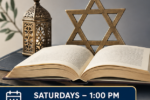
Not the Torah.
On the festival of Simchat Torah, Jewish communities around the world read the Torah’s final words describing the death of Moses, the greatest prophet who ever lived. It is a solemn ending. Moses climbs Mount Nebo, sees the Promised Land from afar, blesses the people one final time, and dies. The Torah concludes by declaring, “Never again has there arisen in Israel a prophet like Moses” (Deuteronomy 34:10).
Yet before the scroll is closed, it is rolled back to the beginning, and the congregation immediately reads:
“In the beginning, G-d created the heavens and the earth…” (Genesis 1:1)
Even more surprising, V’zot HaBerachah is the only Torah portion not read on a regular Sabbath. It is reserved for Simchat Torah so that the Torah’s conclusion can flow directly into its beginning.
Why?
Why does the Torah refuse to end?
Because the Torah was never meant to be a book we finish.
It was meant to be a life we live.
Most books are read once and then set aside.
The Torah calls us back year after year because each time we return, we bring new joys, new disappointments, new questions, and new experiences. A child hears Noah’s ark and imagines animals marching two by two. An adult reads the same story and discovers lessons about courage, responsibility, and faith.
The words have not changed.
We have.
The Lubavitcher Rebbe often taught that Torah is not simply information to be mastered but a living relationship with G-d. Like every meaningful relationship, it deepens over time, and G-d has more to teach us through the same timeless words.
There is another beautiful hint hidden in the Torah scroll itself.
The final letter of the Torah is the Hebrew letter lamed, the last letter of the word Yisrael. The first letter of the Torah is beit, the first letter of Bereishit (“In the beginning”).
Together they spell lev—the Hebrew word for “heart.”
It is a striking image.
The Torah begins where the heart begins.
Learning Torah is not merely an intellectual exercise. It is a relationship. And relationships are never completed simply because enough time has passed or enough pages have been read.
That is why Moses’ death is not the final word.
As heartbreaking as that moment is, Judaism refuses to leave us standing beside his grave. Before we have time to linger there, we are already back at creation itself, reminded that G-d’s work in the world—and our place within it—is beginning anew.
Life unfolds much the same way. We revisit familiar challenges and rediscover truths we thought we had already learned. What feels like going backward is often another step forward, because growth rarely follows a straight line.
The Torah never says, “The End.”
Instead, it quietly whispers,
“Begin again.”
I wish you a good week and Shabbat Shalom,
Rabbi Yonatan Hambourger
This post has been contributed by a third party. The opinions, facts and any media content are presented solely by the author, and Atlanta Jewish Connector assumes no responsibility for them. Want to add your voice to the conversation? Publish your own post here.