
A man sits at a family gathering, half-listening to the conversations around him while scrolling through his phone. Children are laughing somewhere in the background. Plates clatter in the kitchen. People he has known and loved for years sit only a few feet away.
And yet, inwardly, he feels distant from all of it.
Most people know this feeling in one form or another. We live in the most connected age in human history. Messages arrive instantly. Conversations travel across continents in seconds. And yet many people quietly carry the feeling that they are isolated; cut off from one another, cut off from meaning, even cut off from themselves.
Sometimes the deepest loneliness is not physical.
It is the feeling that nothing truly connects.
In Parshat Va’etchanan, Moses reminds the Jewish people of the revelation at Mount Sinai and declares: “You were shown to know that the L-rd is G-d; there is none else besides Him” (Deuteronomy 4:35).
Read plainly, the verse is a declaration of monotheism. There are no other gods. But the great Chassidic masters heard something far more radical in these words.
“There is none else” means more than the rejection of idols. It means that nothing in existence is truly separate from the Divine source that gives it life at every moment.
Rabbi Schneur Zalman of Liadi, founder of Chabad Chassidism, used the image of sunlight to help explain this idea. Sunlight streaming through a window appears independent and self-contained. But in truth, the light has no existence apart from the sun itself. Its entire reality is an expression of something larger than itself.
So too, Chassidic teaching suggests, we often experience ourselves as isolated beings moving through a disconnected world. But that perception may not be the deepest truth about reality.
And if every life draws from the same Divine source, then no human being is ever entirely disconnected from another.
That matters now more than ever.
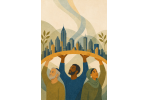
We live in a time when division has become almost instinctive. People are increasingly sorted into categories, tribes, ideologies, and camps. Differences become walls. Disagreement becomes alienation. The modern world often trains us to see one another first as strangers rather than as fellow human beings sharing a common origin and purpose.
The Torah pushes in the opposite direction.
Not toward sameness. Not toward the erasure of differences. But toward the recognition that beneath all the visible distinctions lies a deeper unity.
The revelation at Sinai was not only a moment of commandments and laws. It was also a moment of clarity—a brief glimpse beyond the illusion that we are alone, self-created, and disconnected from one another and from G-d.
Most of us do not live in that clarity for long. We return to ordinary life, to ordinary perception, to ordinary worries. But the memory of Sinai still asks something of us.
To look at the world, and at one another, with greater humility.
And with the awareness that we are far more connected than we realize.
I wish you a good week and Shabbat Shalom,
Rabbi Yonatan Hambourger
This post has been contributed by a third party. The opinions, facts and any media content are presented solely by the author, and Atlanta Jewish Connector assumes no responsibility for them. Want to add your voice to the conversation? Publish your own post here.